Aggie Morton, Mystery Queen
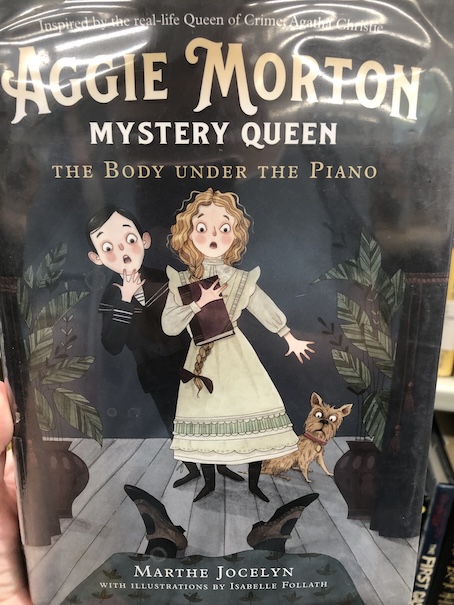
The Body Under the Piano by Marthe Jocelyn, 2020.
Aggie Morton is a twelve-year-old girl living in Torquay, England in the early 1900s. Aggie is painfully shy, but she loves writing and has a fascination for the macabre. She loves reading Sherlock Holmes stories, and she likes to write poetry and imagine her own macabre stories. However, Aggie is painfully shy and has difficulty sharing her writing with others and making friends with children her own age. Although her elder sister was educated at boarding schools, her mother decided to educate Aggie at home, so she is accustomed to studying with just her parents and not to a school environment with other children. She does take dance lessons with other girls, but she never seems to know what to talk to them about. Her life has recently changed because her father has died, her family doesn’t have as much money as they did before, and her older sister has married and left home. She is coping with all of this when a series of strange events changes her life even further.
One day, she makes an unusual new friend, a Belgian boy named Hector Perot. Hector is a refugee who has arrived in Torquay without his parents and is living with the local vicar. Aggie meets him in the candy shop near the place where she takes her dance lessons, and as she soon discovers, Hector shares her fascination for mystery and the macabre.
The girls in Aggie’s dance class give a special performance to welcome the newly-arrived Belgian refugees. Aggie is supposed to give a reading of a poem that she wrote for the occasion, but she is overcome with stage fright. The niece of her dance instructor reads the poem aloud for her, leaving Aggie’s notebook on the piano after the performance.
When the girls return the next day for their usual dance lesson, the dance instructor’s sister-in-law, who is known as a disagreeable woman, is dead and lying underneath the piano. Aggie snatches her notebook off the piano before she is hustled away from the dreadful scene and into the nearby candy shop. There, she once again meets Hector, and she tells Hector and the owner of the candy shop all about the murder.
As the first person on the scene because she just happened to be the first person through the door, Aggie is interviewed by the police and by a very strange local reporter about what she saw. Although finding a dead body is somewhat distressing, because of her fascination for mystery, Aggie is far less distressed than her mother is. Although she usually struggles to get a word out when talking to strangers, she suddenly finds herself with plenty to say to people and lots of questions to ask. To her surprise, her usual shyness doesn’t seem to affect her so much when she’s asking other people questions.
Together, Aggie and Hector ponder who could have wanted this woman dead and who could have killed her in the manner that she was killed. She apparently died by some kind of poison. Her daughter, Rose, the nice girl who read Aggie’s poem for her, would inherit from her mother, and money might be a reason for murder. Then again, perhaps Rose’s aunt, the dance instructor, might have had a reason for wanting her sister-in-law dead.
Then, Aggie discovers that someone has concealed a message for someone else inside the notebook with her poem. The message implies that someone had an unknown sibling and that an inheritance might be involved. Who wrote that message and who was it meant for? Aggie discovers that the killer may be closer to her own home than she thinks, and she herself could be another victim if she isn’t careful.
My Reaction
I really enjoyed this book because I’m a lifelong Agatha Christie fan! Aggie is loosely based on real life mystery author, Agatha Christie, who also grew up in Torquay during the late 1800s and early 1900s. The circumstances of Aggie’s family are similar to that of the real-life Agatha Christie. Hector is based on Agatha Christie’s detective character, Hercule Poirot. Hector is a refugee from Belgium who arrived without his parents and is staying with the local vicar in Torquay. In real life, Agatha Christie based Hercule Poirot on Belgian refugees who came to England during the First World War, in the 1910s. The reasons why Hector is a refugee aren’t entirely defined in the book series because it is set pre-WWI, but if the series was set in WWI, either Aggie would have to be either younger than the real-life Agatha Christie was at the same time or would have to be a young adult instead of a child.
I enjoyed seeing Aggie as a character. In the beginning, she is very shy and has lived a very sheltered life, but she discovers that she can handle death and mysteries better than anyone would have expected. Although she doesn’t completely lose her shyness, her investigations and her friendship with Hector help to draw her out of her shell and fuel her writer’s imagination. I look forward to seeing how she develops through the rest of the series!
I wouldn’t recommend this mystery for very young readers because of the nature of the murder and because the mystery also involves the identity of an illegitimate child. Probably, readers in their tweens or early teens would be old enough to understand. There are also descriptions of a dead body and a dead rabbit that may bother some readers.
 Jestress's Children's Shelf