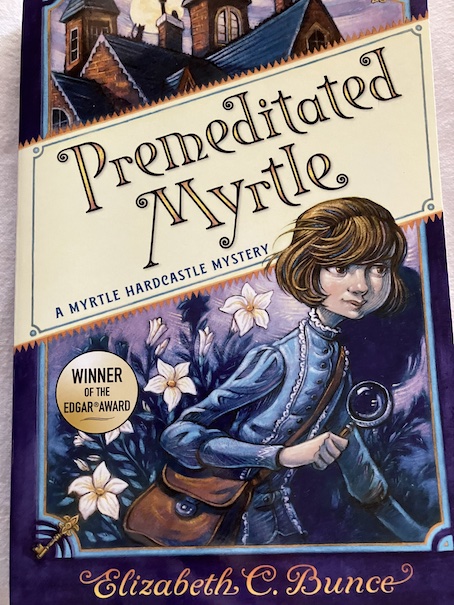
Premeditated Myrtle by Elizabeth C. Bunce, 2020.
Twelve-year-old Myrtle Hardcastle, living in 1890s England, has a precocious interest in forensic sciences. Her scientific investigations are based on her father’s law career and her deceased mother’s interest in medicine, although her father worries that she is morbid and that her interests are highly inappropriate for a girl her age. Her governess, Miss Judson, respects Myrtle’s interests and intelligence, although she does try to restrain her (mostly unsuccessfully) from overstepping the proprieties of their time.
One day, Myrtle comes to believe that something serious has befallen an elderly neighbor, based on the fact that she has not appeared and the gardener and his cat have not made their usual rounds. Miss Judson is concerned at first that Myrtle has alerted the police for no reason, but then, the neighbor his found dead in her bathtub. It appears that she drowned while taking a bath, which could be a simple accident. However, Myrtle suspects foul play. It appears that the neighbor died the night before, and she did not normally take baths during the night.
When Myrtle persuades the coroner to share his findings about their neighbor with her, he says that the neighbor didn’t drown; she apparently died of a heart attack. However, Myrtle still believes that that the neighbor was a victim of foul play. Myrtle knows that certain substances, such as digitalis (which is derived from foxglove plants), can bring on a fatal heart attack. Although Miss Judson takes Myrtle’s theories seriously, Myrtle’s father is still worried that Myrtle is becoming too morbid and isn’t behaving in a way that’s appropriate for a young girl.
The adults begin taking Myrtle’s theories more seriously when the coroner’s further investigations confirm that the neighbor was indeed poisoned with digitalis. The neighbor was mainly known for her love of gardening and her cultivating prize lilies. Since her death, everyone seems interested in learning whether or not she was successful in her attempts to cultivate one particularly rare and valuable lily. If she was successful, nobody seems able to find the plant, and someone has inexplicably destroyed her other lilies.
Everyone suspects the lady’s gardener because he has a criminal record. However, there are other suspects. Could it have been her niece, Priscilla, who has only recently arrived from America and who may not be who she claims to be? It certainly makes Myrtle nervous when the flirtatious Priscilla begins paying too much attention to her widowed father. Then, there is the lady’s nephew, Giles, who is frequently hanging around and smoking those nasty cigarillos. Either of them might have killed the lady to inherit her estate. The answers come a little too close to home for Myrtle’s comfort or safety.
My Reaction
I thought that the mystery was good. We have a set of possible suspects for Myrtle to investigate, and there is a twist with an additional suspect Myrtle initially didn’t think to even suspect but who is present on the scene the entire time. The suspects’ motives make sense, and there are points when all of them look equally guilty. There is one suspect who looks particularly guilty only for there to be logical explanations behind this person’s behavior and suspicious reputation.
I enjoyed Myrtle as a character, although I couldn’t help but notice that she’s also a trope. Myrtle is “not like other girls”, particularly not like other Victorian girls. This is both a good thing and a little cliche. She is shown with other Victorian girls her age, including the coroner’s daughter, who make fun of her for her clothes and weird interests and try to scare her by locking her in the morgue. Of course, Myrtle, not being like other girls, isn’t scared by that at all and uses this as an opportunity to further her investigation. Myrtle does eventually make friends with the coroner’s daughter, when they discover that they do share some interests and when the coroner’s daughter helps her to save a cat who has been poisoned. Myrtle is socially awkward because she has not had friends her own age before and her niche interests don’t appeal to everyone. Still, when she finally makes a friend and is invited on outings, she begins to see the appeal of friendship. Overall, I liked it, although I felt like the other Victorian girls were inserted partly to highlight why Myrtle is eccentric and not accepted by wider society for the very things that make her the heroine of this story. Except for the coroner’s daughter, they don’t really serve any other purpose in the story, although they do provide a way for Myrtle to snoop in a place where she doesn’t belong.
One of the hallmarks of the Victorian era was a rigid social structure, at least much more rigid than what we have in the 21st century. The book does mention that there are certain expectations for the behavior and future of young ladies like Myrtle, but even though her governess does try to get Myrtle to recognize that these social rules exist and that she has to pay some attention to them, it feels like these rules are considerably relaxed for Myrtle. The household that Myrtle lives in has apparently always been unconventional for Myrtle’s entire life because her mother was also an unconventional person. Her father sometimes worries about Myrtle’s future and how Myrtle will fit in with other people, finding friends and functioning in society, but at the same time, he also loves her and appreciates the qualities that make her so different from everyone else. She is a lot like her mother was, and she also helps to resolve a serious situation with her knowledge and abilities. Myrtle’s governess is also an unconventional person at heart, which is why she appreciates Myrtle’s abilities and indulges her interests as much as possible.
However, Myrtle isn’t entirely free from some old-fashioned feelings herself. Myrtle disdains “sensational novels“, a real-world sentiment that dates from before the Victorian era. In the Regency novel Northanger Abbey, Jane Austen refers to heroines in novels who disdain reading novels themselves in order to show their intellectual superiority, and she explains how ironic that is – they are essentially rejecting themselves as shallow fictional characters and disparaging their own readers for reading something fictional. I did smirk a little when Myrtle expressed that sentiment, although it does show that she is a product of her time, at least the highbrow intelligentsia portion of it. Myrtle is highbrow and raised to be part of the intelligentsia, which does tend to set a person apart from others who aren’t, no matter what time period they live in. In a way, I thought that Myrtle’s literary conceit was a nice touch because, otherwise, she would have seemed too much like a 21st century transplant in Victorian clothing. For Myrtle to be believable as a 19th century person, she has to have at least some of their habits, sentiments, and internal contradictions, even if she is an eccentric by the standards of most people of her time. For her to differ on certain ideas from most people of her time makes her an eccentric or a person “ahead of her time”, but for her to differ on everything would make her a time traveler.
There are also signs of a romance between Myrtle’s father and the governess. Each of them seems to have feelings for the other, but neither can quite bring themselves to say or do anything about it. The situation is complicated because there is an employer/employee relationship between them, and they know that a romantic relationship or marriage between them would be somewhat scandalous and have some social consequences. Within their unconventional household, the governess often functions in the role of the lady of the house, but everyone else treats her like the hired help because that is basically her official position. Myrtle would like to encourage a relationship between them and have her governess become her new mother, if her father remarries anyone. However, the situation is complicated, and she’s not exactly sure how to explain her feelings to her father. There are a couple of scenes where Myrtle and her father discuss the future and possible marriages for himself and the governess. Her father points out that, eventually, Myrtle will be too old to need a governess, and her governess will either need to take another job or get married to secure her own future. That means that change will be inevitable, and there is only limited amount of time for them all to consider what that will mean. Although I think that, in the real-life Victorian era, social pressures would likely be too much to allow this relationship to develop further, I’m hoping for a happy ending for them as this series continues!
 Jestress's Children's Shelf