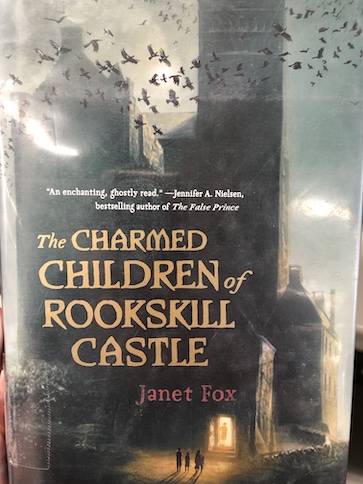
The Charmed Children of Rookskill Castle by Janet Fox, 2016.
In 1940, in London, the coming of the Blitz during World War II means that children must be sent away to escape the bombings. Kat Bateson and her siblings are told that they will be sent to Rookskill Castle.
Rob is excited about going to a castle because it might be haunted and they might learn all kinds of Medieval fighting skills, like fencing and archery. Kat says that the castle is now called Rookskill Castle Children’s Academy, so they’ll probably just be having standard lessons. Rob thinks that she’s being stodgy and boring. Their little sister, Amelie, thinks that ghosts sound exciting, but 12-year-old Kat is sure that there won’t be ghosts. The castle is owned by the children’s distant relatives, and Kat is more worried about practical things, like their father’s war work with MI-6 (he is a spy, although they are not supposed to talk about it), how she will fit in with other children at school, and packing warm clothes for Scotland.
Before the children leave for Scotland, Great Aunt Margaret gives her something for protection – her chatelaine. The chatelaine is a family heirloom that holds a pen, scissors, and thimble attached by chains to a ring. Great Aunt Margaret says that it’s magical, and she warns Kat to be careful with magic because magic always comes at a price. Kat doesn’t really believe in magic, like her younger siblings do. She is practical and enjoys numbers, puzzles, and the clockwork skills that her father has been teaching her. Still, she accepts the chatelaine from her aunt. Her aunt tells her that the pen will write by itself, the scissors will cut anything, and the thimble has the power to capture souls.
Kat and her siblings make the trip to Scotland along with Peter, the American son of people their mother works with. The Bateson children like Peter, and they become friends. However, when they reach Scotland, the station master warns them away from Rookskill Castle, talking about strange stories about the place and other children who have gone there and haven’t been seen since. The children are spooked by what he says, but they have no choice but to go with the man from the castle who comes to pick them up.
When they arrive at Rookskill Castle, they all find the place creepy. The boys find the lady who runs the castle school, Eleanor, to be pretty and charming, but the girls find her creepy. Kat thinks that there is something wrong with her, although she’s not sure what. Eleanor also wears a chatelaine, although Kat doesn’t think hers is as good as the one Aunt Margaret gave her. Aunt Margaret’s chatelaine holds practical items, but Eleanor’s chatelaine holds strange-looking charms with no practical use. Kat doesn’t know what the point of them is, but she prefers Aunt Margaret’s chatelaine.
The children are told that they will share rooms – Peter and Robby together and Kat and Amelie together – and that they must wear school uniforms, which is typical of a boarding school. However, they are also told that they will be locked in their rooms at night, which sounds alarming, and that if they hear any strange noises, they should ignore them because old castles make odd sounds. They are not allowed to wander the grounds and explore.
The children and the other students at the school soon begin to see and hear strange things around the castle. They see other, mysterious children, who are not students but who may be ghosts. The boys hear strange noises coming from a secret room that Kat thinks sound like a radio. Kat thinks that the radio sounds might indicate that there is a German spy at the school, someone who is communicating with someone outside in secret. That would make sense for wartime Britain, but it can’t explain the other, frightening things that are happening at the castle.
There is something wrong with the teachers and the cook at the school. Their memories are sometimes muddled, and they seem to be easily confused about certain things. One of their teachers keeps talking about special artifacts with magical powers that could decide the course of the war, including a magical chatelaine once owned by Vlad the Impaler.
The longer they’re at the school, the more everyone seems to be affected by the place. Kat becomes certain that the students’ cocoa is drugged every night, and Lady Eleanor isn’t what she appears to be. Really none of the adults in the castle is quite what they appear to be, but Lady Eleanor is particularly sinister. In a series of flashbacks, it is revealed that she has led an unnaturally long life because of a magical pact she made centuries ago. In order to gain the power she craves, she needs the souls of children. Logical Kat needs to grasp the idea that there is magic and take possession of her own magical potential to save herself and the others in a terrifying showdown on Halloween night.
My Reaction
I really enjoyed the combination of magic and historical fiction in this story! I’ve read other books that combine the real-life experiences of WWII child evacuees with magic and fantasy. Many people would remember that the children in The Lion, the Witch, and the Wardrobe were child evacuees, but there are other books with similar themes, like Stonestruck by Helen Cresswell. There are several things that make this book different from others of its type, and I love that this book fits well with the Dark Academia aesthetic that’s been popular during the last few years.
One thing that appears in this story that I haven’t seen in similar ones is the use of mathematics and engineering skills alongside magic. Kat’s talent for mathematics and puzzles have practical uses during their adventure, and so does her budding talent for clockwork and machinery. There is both real machinery in the form of code machines and magical machinery in the story, and Amelie comments on the similarity between magic and the incredible results produced by Kat’s mathematics and by machines. I like the juxtaposition of real skills needed for invention and creation alongside the magic.
There is also a double threat in the book – the magical one and the more standard wartime threat of spies. The book’s premise of Nazis being interested in supernatural artifacts also has some basis in history. Movies like Indiana Jones and the Raiders of the Lost Ark are actually correct that there was an element of superstition in Nazism, and Nazis did attempt to use folklore and antiquities to create or build a connection to the past and to powerful figures. (There are many videos and documentaries on YouTube that offer more details about this. I recommend the ones from National Georgraphic, the Smithsonian Channel, and various universities as being the most authoritative and reliable.) The Nazi concept of history was really more of a fan fiction about their imagined past glories rather than sound and real history, and it was meant to serve as an inspiration for the empire they wanted to create. The book was correct that the darkness of war brings out magic, after a fashion. Even Allied countries, like Britain, saw a rise in spiritualism because of the war as people tried to connect to the spirits of lost loved ones, and this was also the time when Wicca began evolving into a religious movement. In fact, the founders of Wicca in Britain attempted their own magical ritual in the New Forest to ward off the Nazis. (The incident is recounted in this documentary about the life of the founder of Wicca by Professor Ronald Hutton of the University of Bristol.) In times of chaos, people are prepared to try anything and everything they can to protect what’s important, and that can include magic. The real life Wiccan rituals were not like the magic in this book, but I found it interesting that the fantasy of this story built on some real-life wartime attitudes about the supernatural.
I like books that include interesting and unusual historical details. Although this is a fantasy story, the experiences of the child evacuees do resemble the experiences of real-life evacuees. I enjoyed reading about their train journey from London to Scotland and the black-out curtains that even the trains have. Many books about child evacuees have them sent to live in private homes with people they don’t know, but in real life, there were some evacuees who were sent to boarding schools instead.
The use of a magical chatelaine is a charming touch that also shapes the nature of the story. A chaletaine is an unusual piece of jewelry that isn’t commonly worn anymore, which makes it different from stories that make use of charmed necklaces and rings. A chatelaine is a belt hook with items joined to it by chains. The items can be practical items, like the ones on Kat’s chatelaine, or charms, like the ones on Eleanor’s. Each of the items on the chatelaines in the story has a purpose.
There are also themes about power in the story. Eleanor craves power. When she was younger, before she began living this unnatural life, she craved love, but she was abused and neglected. She was powerless and fearful of the people who abused her, and her quest for power is to make herself invulnerable to that type of abuse again. However, in the process, she has sacrificed her humanity and placed herself in the position of being used by someone much more powerful. Readers and the characters can feel sorry for her because of her past life experiences, but she is beyond the point where they could save her from herself, the choices she’s made, the things she’s done to other people, and the evil force that has used her. The book is a little open-ended, with the villain behind the villain still lurking around at the end with a mission of his own to accomplish, and this story has a sequel, The Artifact Hunters.
 Jestress's Children's Shelf